
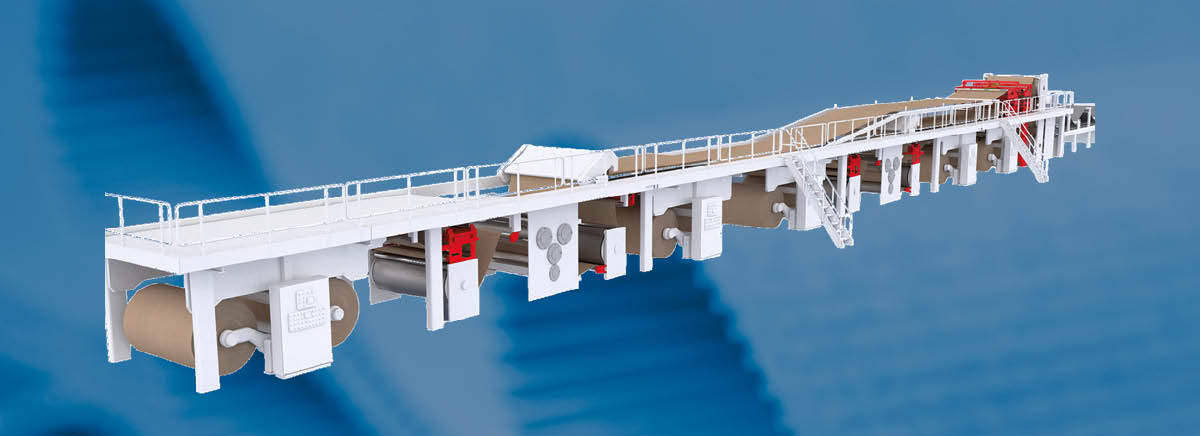
Corrugated Industry in Transition: Efficiency Requires Stable Processes
The corrugated industry is changing on several levels at the same time: overcapacity and price pressure are shaping the market, while paper and energy remain key cost factors.
At the same time, market consolidation and plant closures are changing the competitive landscape.
Requirements for resource and material efficiency are also increasing. Reduced excess paper width, less side trim and lower paper and starch consumption are becoming important economic levers.
The trend towards lower grammages supports both cost and sustainability targets but also places greater demands on the production process.
At the same time, energy efficiency, automation, digitalisation and process reliability are becoming increasingly important. Qualified process know-how and specific knowledge of paper are no longer available to the same extent everywhere. Data analysis and AI offer new opportunities to optimise production parameters, automate process control and enable continuous improvement.
Production speeds are also increasing – and with them the requirements for reproducible quality and machine availability.
As a result, predictive maintenance is also moving further into focus.
Based on many discussions with corrugated board manufacturers, these facts most frequently come down to two key topics in day-to-day production:
1. Energy efficiency starts with process reliability
Energy efficiency is often initially assessed in terms of the consumption of individual units. However, this does not provide a comprehensive economic picture.
Every unnecessary loss of speed, every additional start-up and every piece of waste produced consumes energy and materials without creating any additional value.
The guiding principle is:
Influence the paper as little as possible, but as much as necessary.
This conserves resources while creating the conditions for stable, reproducible production.
Web guiding: A few millimetres with a major economic impact
Paper is expensive. Making optimum use of it is therefore a direct economic factor.
Advanced paper alignment systems are designed to align paper webs automatically, precisely and instantaneously. They create the conditions for minimum side trim, maximum width utilisation and precise alignment even during order or reel changes. Reproducible quality can be maintained even at high production speeds.
Web tension control: Essential for board flatness and converting
In addition to lateral web position, tension in the machine direction is a critical process parameter, as fluctuations can affect the flatness of the corrugated board.
Modern web tension control systems maintain defined target values even when production speed or bridge volume changes.
Consistent board flatness supports both quality and productivity in downstream converting processes. At the same time, unnecessarily high web tension can be avoided – which, under suitable conditions, can also help reduce energy consumption.
2. Predictive maintenance instead of unplanned downtime
Unplanned downtime is one of the cost-intensive events in day-to-day production. This is particularly critical for the corrugator, as downstream converting processes may depend directly on its availability.
Maintenance is therefore increasingly evolving from a reactive to a predictive approach: condition monitoring, process data and scheduled maintenance intervals help identify deviations at an early stage and allow maintenance activities to be prepared more effectively.
The goal is not to carry out as much maintenance as possible, but to perform the right maintenance at the right time. This helps increase machine availability, reduce unplanned downtime and improve the planning of service activities.
E+L: Process know-how instead of isolated solutions
This is precisely where E+L Corrugated Division comes in. The focus is not simply on an individual component, but on how individual production steps can be made more precise overall to combine several economic objectives.
Based on many years of experience, E+L system solutions stand for:
- high measurement and control accuracy, even at high production speeds and during speed changes
- stable process control and reproducible quality
- modular systems for different machine configurations
- networking and communication with the entire corrugator
- high machine availability and low maintenance requirements
- less waste and improved material utilisation
- measurable Total Cost of Ownership benefits
The result: less waste, more efficient use of energy and materials, higher machine availability and reproducible quality.
Learn more about Erhardt+Leimer solutions for the corrugated industry on our website: https://www.erhardt-leimer.com/global/en/industries/corrugated-board/corrugated-board-system.html
Or contact our sales team directly to find out which maintenance recommendations and maintenance intervals are suitable for your application to reduce unplanned downtime and secure long-term machine availability: sales-corrugated@erhardt-leimer.com
Frequently Asked Questions (FAQs)
Higher production speeds, lower paper grammages and changing paper qualities increase the need for precise and reliable process control.
By continuously adapting production parameters to actual process and ambient conditions, energy can be used more efficiently. Stable processes help avoid unnecessary energy input, speed reductions and waste while maintaining consistent product quality.
Precise web guiding reduces side trim, material waste and misalignment, helping manufacturers make better use of the full paper width.
Stable web tension supports consistent board flatness, reproducible quality and reliable downstream converting processes.
Predictive maintenance helps detect deviations early, reduce unplanned downtime and improve machine availability.
E+L combines long-standing industry experience with precise, modular system solutions designed to ensure maximum corrugator & conversion productivity, as well as optimum box performance.